Our History
We Have Always Been Snohomish
Our history lives in named places and families: the Snohomish River country, the villages of Whidbey Island, and relatives whose lives connected the rivers with the communities across the Sound.
didiʔɫ čəɫ ʔa
We Are Still Here.
Before the treaty
Our ancestors lived in villages along the Snohomish River and its tributaries, at the river mouth, and on the shores and islands of Possession Sound. Hibulb, Cultus Bay, Sandy Point, and Bush Point were places of houses, fishing, family life, and gathering.
Canoe travel connected these communities. Marriage and family responsibilities connected our people with neighboring Tribal peoples. Our history began here long before reservations and federal enrollment systems.


The Treaty of Point Elliott
The Treaty of Point Elliott, concluded at present-day Mukilteo, names the Snohomish among its parties. Its signer list identifies Snohomish leaders including Snah-talc, also recorded as Bonaparte, and S’heht-soolt, also recorded as Peter.
The treaty provided for land cessions and reservations and recorded fishing rights and hunting and gathering provisions. It was ratified in 1859. Article 4 required removal within one year after ratification, or sooner if the means were furnished.
The treaty did not begin our history. It changed the conditions under which our people had to live.
Read the treatyTranslation and understanding
The written treaty was in English. At the council, English was interpreted into Chinook Wawa, then into the languages of the people, including Lushootseed. This process could convey general meaning without precisely expressing every legal term in the English document. Our ancestors brought laws and diplomatic traditions of their own to those negotiations. The promises they heard must be understood in that context.
Promises and removal
The United States promised support for moving and settling, payments, education, and medical care. Agency reports and Snohomish testimony describe delayed or missing support, poor conditions, and limited cultivable land at Tulalip. Snohomish leaders called on the government to fulfill its promises. Remaining in a village, leaving Tulalip, or seeking work and refuge with relatives must be understood alongside those conditions. There was no single path for every Snohomish family.
Displacement and loss
What happened to our communities
During the territorial wars of 1855–1856, Indigenous families were confined at designated places on Whidbey Island. At Cultus Bay, Snohomish people and allied communities lived under an Indian sub-agent’s supervision. At Holmes Harbor, families brought from mainland communities faced confinement, sickness, and shortages of food.
Logging, farming, and settlement displaced river communities. On Whidbey Island, our people continued gathering at the Bush Point potlatch house after the treaty. In 1886, that house was dismantled and burned.
These losses affected where people could live, obtain food, and gather. Families responded by seeking work, staying with relatives, maintaining homes where they could, and traveling between communities.
Disease across our communities
Smallpox, tuberculosis, and influenza devastated Snohomish families living on and off reservations. Historical records often called tuberculosis “consumption.” Our family histories record the deaths of parents, children, and elders. These losses broke apart households and interrupted the care and knowledge passed between generations.
Our children and the boarding schools
Indian boarding schools took Snohomish children from families living on and off reservations. Our children were separated from parents and relatives under policies intended to replace their languages and ways of life. They faced punishment for speaking their languages, harsh discipline, and disease. Our present Tribal families and our relatives at Tulalip carry these histories today.
Different places, continuing relationships
Tulalip is an important home for many Snohomish relatives. Our families also have histories outside the reservation, including on Whidbey Island, along the rivers, and at Chimacum Creek and Port Ludlow.
Across these places, relatives continued to visit, marry, work, gather, and care for one another. Our homeland account follows some of these connections through Boeda Strand, William Hicks, Sultan John, and Willow Point Tom and Susie.
Our History
We are the Snohomish Tribe of Indians. Our members are Snohomish people who are not enrolled in the Tulalip Tribes. Our families include descendants of Snohomish people who stayed on Whidbey Island, along the rivers, and elsewhere in our homeland. We share ancestors with Snohomish relatives at Tulalip. We continue to govern ourselves as the Snohomish Tribe of Indians.
On January 22, 1855, nine Snohomish leaders signed the Treaty of Point Elliott. They had the honor and the responsibility of speaking for our people. When we remember them on Treaty Day, we remember what it meant to give their word on behalf of their families and the generations who would come after them. We are among those generations.
Our ancestors spoke Lushootseed. The United States wrote the treaty in English. At Point Elliott, interpreters carried the negotiations from English into Chinook Jargon, a trade language, and then into the languages of the people gathered there. A Snohomish man who understood English helped interpret. We still have the English words the United States put on paper. Even for a promise as important as the right to fish where our families had always fished, no record preserves the exact words used to explain it.
Our Tribe remembers a promise made at treaty time: our people would have a land base of our own, separate from the reservation at Tulalip. The United States ratified the treaty in 1859. The very next year, a federal official recommended against establishing a separate Snohomish reservation. The United States kept the lands our ancestors ceded. Our families are still waiting for the land base they understood had been promised to us.
Some Snohomish families made their homes at Tulalip. Some of our families stayed in other parts of our homeland. We remained relatives. Where a family lived, however, came to matter a great deal in its dealings with the federal government. By 1930, federal officials were already treating Snohomish families outside the reservation differently in matters of representation. Reorganization at Tulalip under the Indian Reorganization Act of 1934 deepened that division. Our families outside the reservation had already been meeting, enrolling members, and conducting the business of the Snohomish Tribe of Indians. We published our bylaws in 1928, six years before Congress passed the Act.
Generations after the United States accepted our ancestors’ signatures, our families had to petition that same government for federal acknowledgement. It denied our petition. Our elders kept the meeting minutes, letters, rolls, and family histories that we hold today. They also gave us things no petition could capture: the knowledge of who our relatives are, the places we belong to, and the responsibility to show up for one another. Today we gather with our elders and grandchildren, learn our language together, and work toward a place of our own for ceremony, culture, and community.
We are here because we never stopped being Snohomish.
Organizing as Snohomish people
- 1855
Treaty of Point Elliott
The treaty, concluded at present-day Mukilteo on January 22, names the Snohomish among its parties. It records land cessions, reservations, and reserved fishing, hunting, and gathering provisions.
- 1859
Treaty ratification
The treaty is ratified on March 8 and proclaimed on April 11.
- 1886
Bush Point potlatch house
The Tribe’s later historical account records that the Bush Point potlatch house remained in use until 1886, when it was reportedly demolished and burned.
- 1917
A Snohomish council at Monroe
A November 2 agency letter describes a Snohomish council held at Monroe and notes that people living at Tulalip attended.
- 1919
Snohomish families in the Roblin schedule
Charles Roblin’s Schedule of Unenrolled Indians records named Snohomish individuals, families, and their places of residence across the region.
- 1923
An enrollment committee
On April 26, Snohomish people meet at the Potlatch House at Tulalip and elect a committee to consider enrollment applications. The minutes also record an ongoing inquiry into logging operations.
- 1927
Incorporation and Tribal business
Articles of incorporation are filed on August 8 under the name Snohomish Tribe of Indians. October meeting minutes record plans for a race canoe and a pageant, alongside correspondence and recordkeeping.
- 1930
A debate over representation
At the March 29 meeting at Tulalip, Robert Shelton explains that some Snohomish members live off reservation because there is insufficient land for allotments. He argues that members still on the Snohomish roll should have a voice in council selection and Tribal property.
- 1950
Meeting to discuss claims
The Tribe’s compiled meeting history records an August 12 annual meeting at Tulalip’s Old Dining Hall, attended by Acting Superintendent F. A. Gross and Tulalip Chairman Wilfred Steve, to discuss claims.
- 1967
Funds appropriated for the Snohomish judgment
Congress appropriates funds on May 29 to pay the judgment in the Snohomish Tribe’s Indian Claims Commission case, Docket 125.
- 1971
Judgment distribution legislation
Public Law 92-30, approved June 23, directs preparation of descendant rolls and per capita distribution of judgment funds for Snohomish and other named Tribes, under the law’s eligibility requirements.
- 1975
Research on identity, treaty status, and fisheries
Anthropologist Barbara Lane completes a report on the Snohomish Tribe of Indians, dated June 20, examining Snohomish history, descendants, treaty status, and fisheries.
- 1979
A federal acknowledgment petition
The Tribe prepares a petition under the federal acknowledgment regulations. The surviving copy includes a statement signed by Tribal leadership in November 1979.
- 1983
A proposed finding against acknowledgment
The federal government publishes a proposed finding against acknowledgment on April 11. This is a preliminary stage; the final determination follows in 2003.
- 1988
Written testimony to the Senate
John M. Kidder, Financial Secretary, submits supplemental written testimony to the Senate Select Committee on Indian Affairs on June 10, addressing the acknowledgment process, delays, and their effects on Snohomish people.
- 1991
Advocacy for acknowledgment reform
Chairman Alfred B. Cooper presents the Tribe’s statement to the National Congress of American Indians’ task force in March, calling for consistent criteria and an independent review process.
- 2003
Final determination declines acknowledgment
The Department of the Interior issues its final determination declining federal acknowledgment in December. The notice is published on December 10.
- Today
Our work continues
We continue to govern, preserve records, reconnect families, teach language and culture, gather as Snohomish people, and carry our restoration work forward.
Our records name people who carried responsibilities for the Tribe. In October 1927, meeting minutes record decisions to purchase a race canoe, commission a pageant, maintain correspondence and files, repay money William Shelton had lent the Tribe, and compensate women who cooked the meeting dinner.
Later correspondence and testimony document research, enrollment work, meetings, and advocacy. A February 1988 letter reports that an Administration for Native Americans grant supported the Tribe’s acknowledgment response and renewed participation by members. Preserving these records keeps the people and their work available to future generations.
Sources for this timeline
- Treaty of Point Elliott: treaty text and ratification dates.
- Snohomish Tribal archives: Box 007, “Roblin Shows,” PDF pages 8–11 and 25–34; November 2, 1917 agency correspondence and January 1, 1919 enrollment schedules.
- Snohomish Tribal archives: Box 007, “1923 Officers; 1927 Incorp,” PDF pages 2 and 7–14; April 26, 1923 minutes, October 2, 1927 minutes, incorporation certificate, and organizational minutes.
- Snohomish Tribal archives: Box 003, March 29, 1930 meeting minutes, PDF pages 2–3.
- Snohomish Tribal archives: Box 034, “Background Materials,” PDF page 284 (the Tribe’s historical account of Bush Point); page 409 (compiled annual meeting history); pages 3–6 (Barbara Lane’s 1975 report); pages 43–49 (1979 petition). These are source PDF page numbers, including covers.
- Public Law 92-30, June 23, 1971, 85 Stat. 83–84: judgment funds, the 1967 appropriation, descendant rolls, and distribution.
- Snohomish Tribal archives: Box 004, February 1988 correspondence packet, PDF page 18; John M. Kidder’s February 5 letter concerning the Administration for Native Americans grant.
- Snohomish Tribal archives: Box 003, John M. Kidder’s supplemental written testimony, June 10, 1988, PDF pages 2–8; Chairman Alfred B. Cooper’s NCAI task force statement, March 1991, PDF pages 2–4.
- Federal Register notice, December 10, 2003, 68 FR 68942–68944: final determination and the date of the 1983 proposed finding.
Federal acknowledgement
The Snohomish Tribe of Indians is not currently federally acknowledged. The U.S. Department of the Interior issued a final determination declining federal acknowledgement in 2003.
Our identity and responsibilities to one another continue while we pursue acknowledgement.
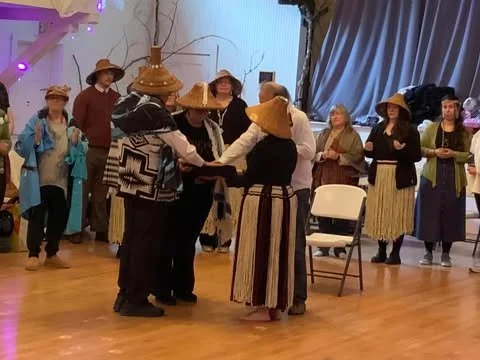
Our Story Continues — Snohomish homelands.
Our story continues
We Are Still Here
Today, the Snohomish Tribe of Indians continues to govern, reconnect families, strengthen enrollment records, revitalize language and culture, care for our homelands, preserve our history, gather as Snohomish people, and carry restoration work forward.
We remain connected to Snohomish relatives at Tulalip and throughout the region. Their identity is not diminished by ours, and ours is not erased by theirs.